What Is Microencapsulated Milk Thistle Seed Oil Powder?
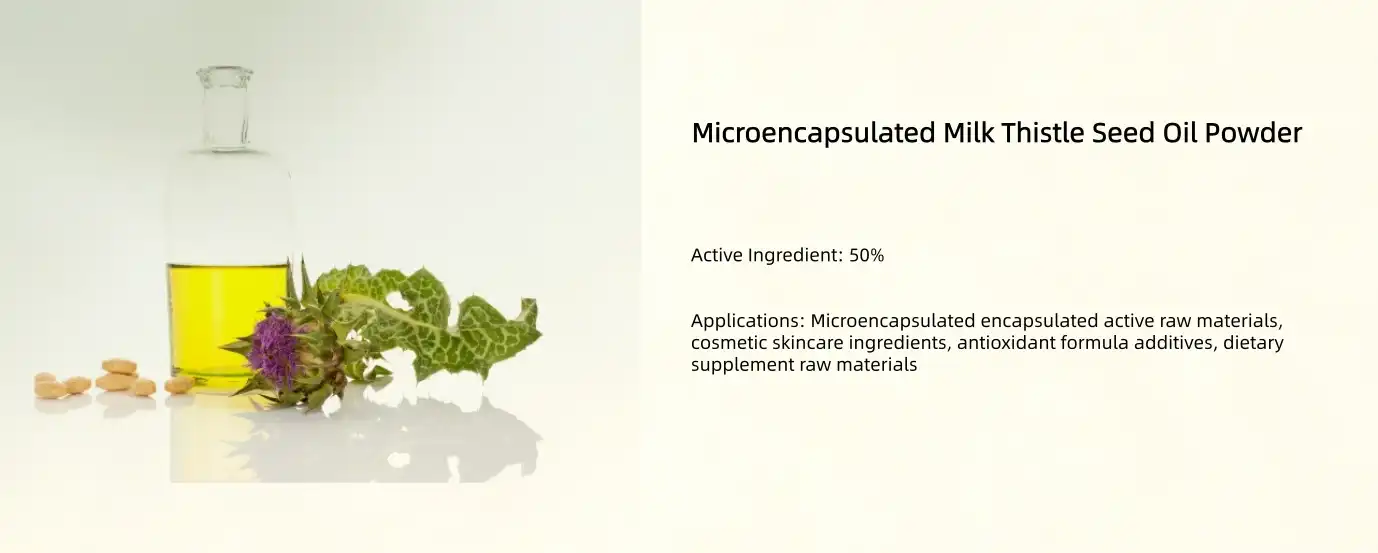
Microencapsulated milk thistle seed oil powder is a solid-form functional lipid produced by enclosing cold-pressed Silybum marianum seed oil within a protective starch-based wall matrix through spray-drying technology. This process converts liquid oil into a stable, free-flowing powder that retains naturally occurring bioactives—including linoleic acid (Omega-6), tocopherols, phytosterols, and trace silymarin (0.5–1%). The result is an ingredient engineered to solve three persistent formulation challenges: oxidative rancidity, poor aqueous dispersibility, and the bitter sensory profile that limits consumer adoption in liver health supplements, RTD beverages, and functional foods.
Why the Liver Health Supplement Market Needs a Better Ingredient?
The global liver health supplement market keeps growing because more people are becoming aware of how much alcohol people drink, metabolic health concerns are rising, and people in Asia, North America, and Europe want more clean-label nutraceuticals. Still, most formulas still use standardized silymarin extracts, which is a very crowded and narrow group that makes it hard to tell them apart.
There is a real innovation gap for product managers who are looking for ingredients for liver support pills, detox RTD drinks, or meal replacement powders. Labels with ingredients are getting more and more detailed, and "milk thistle extract 80% silymarin" doesn't stand out as much as it used to. The market needs an ingredient with a stronger and more believable story—one that comes from whole seeds, is processed in a clean way, and has bioactivity that can be measured beyond flavonoids alone.
This is exactly where microencapsulated milk thistle seed oil powder makes a big difference.
Understanding the Science Behind Microencapsulation
How the Encapsulation Process Works?
Spray-drying microencapsulation breaks up an oil-in-water emulsion into tiny droplets that dry quickly into separate powder particles. There is an oil core in the middle of each particle, and the walls are usually made of modified starch, maltodextrin, or gum arabic. Our special double-wall method at Easy Health Inc. adds a second barrier layer, making a shell around each droplet of cold-pressed milk thistle seed oil that blocks air.
What the Wall Matrix Preserves?
The containment grid does more than just keep things from leaking. It actively protects unsaturated fatty acids from photooxidation, keeps silymarin intact at pasteurization temperatures of up to 180°C, and reduces the bitter taste of raw milk thistle oil by about 90% when mixed with water. Rancimat oxidative stability testing confirms a significantly longer Induction Period compared to bulk oil that has not been encapsulated. This directly translates to a 24-month shelf life compared to about 6 months for raw oil.
Encapsulated Powder vs. Traditional Milk Thistle Oil: A Practical Comparison
When formulators look at this group of ingredients, they often want to know how they stack up against liquid milk thistle oil and standardized silymarin extracts. The differences are important for business and operations.
When dealing with large amounts of liquid cold-pressed milk thistle oil, it can be hard to handle because it needs to be stored in a neutral atmosphere, it can't be pressed into pills without oil leaking out, and it forms oily rings on the surface when mixed into drinks. On the other hand, standardized silymarin extracts don't have any fatty acids or information about where the whole seed came from, which makes them hard to place as "clean labels."
Both of these problems are fixed by our microencapsulated milk thistle seed oil powder. When the surface oil level is kept at ≤1.0% (compared to the average of 2–3% in the industry), it flows easily through high-speed capsule filling equipment and doesn't separate when compressed under tableting pressure. It dissolves right away in cold water, making a clear solution that doesn't leave behind the oily film that most liquid forms do. These are not small improvements; they are necessary for commercial production on a large scale to be possible.
Key Technical Specifications and Quality Benchmarks
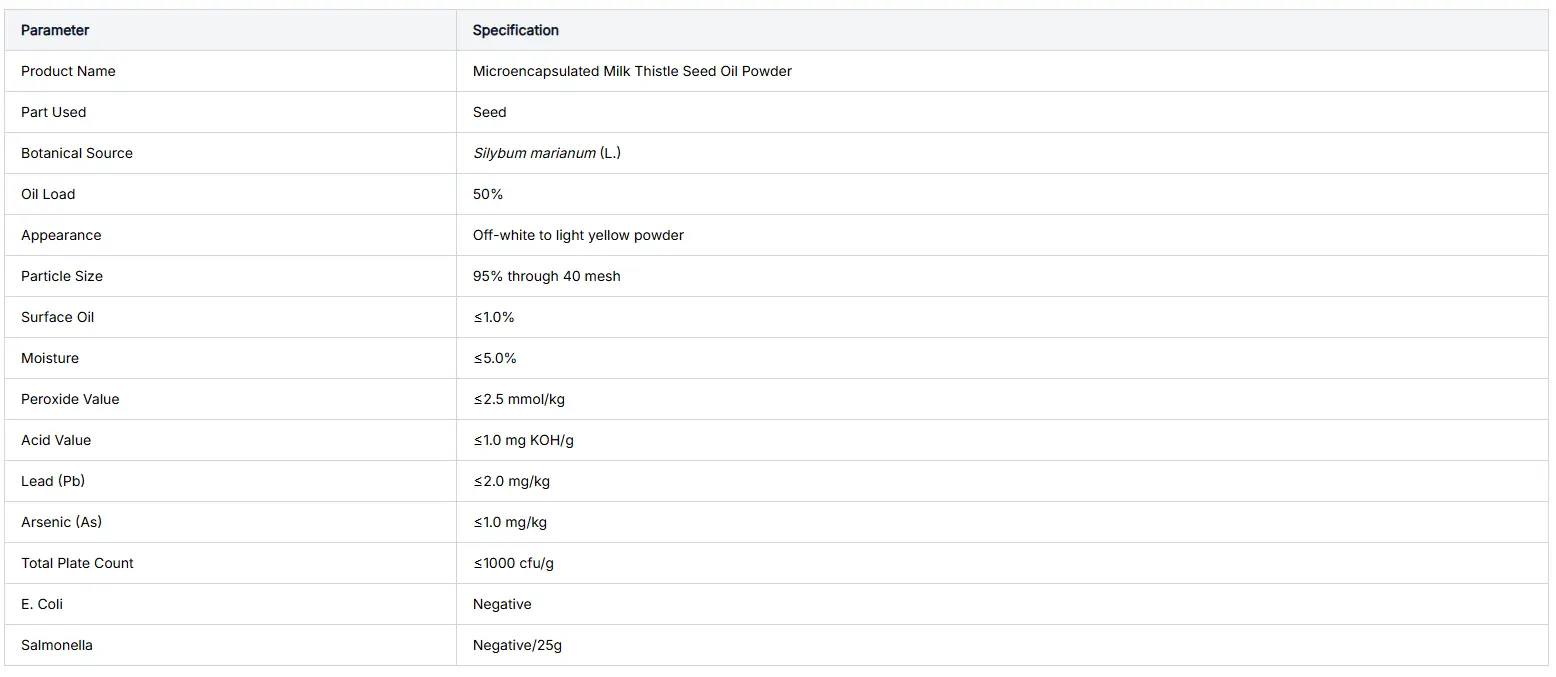
Before agreeing to a new ingredient, procurement teams and quality assurance managers need to see real statistics. This is everything you need to know about Easy Health's microencapsulated milk thistle seed oil powder:
The specification for a 50% oil load is the best balance between encapsulation efficiency and oxidative stability. Higher oil loads are technically possible, but they weaken the walls, which makes the oil on the surface rise and speed up rancidity. Each shipment comes with a full Certificate of Analysis. Heavy metal screening for lead, arsenic, cadmium, and mercury is done in line with USP standards.
Formulation Applications Across Product Categories
The performance profile of this ingredient creates significant chances in a number of nearby areas. It's worth taking a close look at the three most economically important uses.
Here are the primary formulation use cases that product teams across industries have validated:
- Liver support capsules and tablets: The powder's ability to flow freely allows for high-speed automatic capsule filling at throughputs higher than those possible with regular oil-absorbing powders. The double-wall matrix keeps its structural integrity when the tablet is compressed. This stops the oil from moving around, which happens in regular lipid-based tablets and makes them stick together and give the wrong amount. This means that it can be directly swapped out for other liver support SKUs without having to change the line.
- RTD beverages and functional meal replacements: The ability to disperse in cold water is the most important factor here. The microencapsulated matrix wets and suspends evenly without any oil pooling on the surface, which is a sensory flaw that makes people return bottled detox drinks. Because the ingredient is stable at 180°C, it can withstand both UHT and Maillard processing, which means it can be used in more hot-fill forms and cooked meal replacement packs.
- Cosmetic and topical formulations: The antioxidant-rich lipid makeup, which includes tocopherols, phytosterols, and linoleic acid, can be used directly in anti-aging and skin barrier repair products. Powder dosing is more accurate from batch to batch than bulk oil, and the longer shelf life makes it easier for contract makers who work with regular production cycles to keep track of their inventory.
These applications collectively demonstrate why microencapsulated milk thistle seed oil powder really does meet the needs for clean labels, technical performance, and a lot of different formulation options—something standardized extracts alone cannot address.
Procurement Guide: What to Verify Before You Source?
To find a good supplier for this ingredient, you need to look at more than just the product datasheet. The best way to tell if something will be stable in the long term is to compare its encapsulation efficiency, which is found by comparing its total oil content to its surface oil through solvent extraction. Ask for this number directly; reputable manufacturers usually give it.
Getting into a market requires certain certifications. Easy Health Inc. is registered with the FDA, ISO, Halal, Kosher, and other organizations. It is also in line with the USDA NOP and the EU Organic standards for markets that need organic placement. Halal and Kosher paperwork often completely blocks distributor deals for names that want to sell in Japan, South Korea, or Southeast Asia.
Pilot sampling has to be done. Specifications alone can't tell you anything about how well it masks bitterness, how well it mixes in your specific beverage matrix, or how it compresses in your tablet tooling. Before committing to quarterly numbers, a structured sample-to-pilot-to-small-batch process (starting at 50–300 kg) protects the investment in the formulation.
Conclusion
Microencapsulated milk thistle seed oil powder is a great way for brands that make liver health products, functional drinks, and clean-label nutraceuticals to change the way their products are made. Cold-pressed origin, double-wall bitterness masking, ≤1.0% surface oil, and 180°C thermal stability are not small improvements; they are the technical basis for a product that can really be set apart. If your procurement and research teams are ready to move on from normal silymarin extracts, this ingredient is a safe, legal, and consumer-friendly option that comes with an interesting origin story.
FAQ
How does shelf life compare between encapsulated powder and bulk milk thistle oil?
When stored properly, raw cold-pressed milk thistle oil usually stays stable for 6 months. By physically keeping air and light from getting to the unsaturated fatty acid core, the microencapsulated milk thistle seed oil powder shape makes that window last 24 months. This lowers the risk of spoiling and makes foreign shipping easier.
Does microencapsulation affect the bioavailability of silymarin or fatty acids?
Modified starch and maltodextrin are used as wall materials because they are made to dissolve quickly in the stomach. Bioactive release works well after consumption, and the packaging process doesn't change the silymarin or fatty acid profile chemically.
What certifications should I require from a supplier?
Check the paperwork for ISO, GMP, and microbiological tests at the very least. Halal and Kosher certifications are often needed to sell goods in global markets. Full heavy metal COA (Pb, As, Cd, and Hg) and Salmonella/E. coli testing should go with every batch of production.
Is the powder suitable for clean-label positioning?
Yes, cold-pressed origin and plant-based wall materials back up claims of natural sources. The small amount of silymarin that is kept from cold pressing (0.5–1%) is not present in refined oil alternatives, which is another thing that makes this label different.
What is the minimum order quantity for sampling?
Pilot quantities usually start at 50–300 kg, and standard stock is ready to ship right away.
Request Samples from Easy Health — Trusted Microencapsulated Milk Thistle Seed Oil Powder Supplier
Easy Health Inc. sells microencapsulated milk thistle seed oil powder that is safe for use in medicines. They offer low minimum orders, all the necessary paperwork for regulations, and committed research and development help to make the best formulations. Our technical team is ready to help you with your project from the sample stage all the way through commercial scale, whether you're making a new liver health pill or changing the way an RTD detox drink is made. You can get your sample and detailed information right now by emailing devin@easyhealthbio.com or going to easyhealthinc.com today.
References
1. Abenavoli, L., et al. "Milk Thistle (Silybum marianum): A Concise Overview on Its Chemistry, Pharmacological, and Nutraceutical Uses in Liver Diseases." Phytotherapy Research, 2018.
2. Muhammed Majeed, et al. "Microencapsulation of Sensitive Bioactives for Functional Food and Nutraceutical Applications." Journal of Functional Foods, 2020.
3. Bhosale, R.R., et al. "Microencapsulation: A Review of Process and Applications." International Journal of Pharmaceutical Sciences and Nanotechnology, 2013.
4. Pandey, K.B., & Rizvi, S.I. "Plant Polyphenols as Dietary Antioxidants in Human Health and Disease." Oxidative Medicine and Cellular Longevity, 2009.
5. Nazzaro, F., et al. "Encapsulation of Bioactive Compounds and Their Application in the Food Industry." Journal of Nutritional Science, 2022.
6. Wallace, T.C., et al. "The Dietary Supplement Market in the United States: Current Status and Future Trends." Nutrition Today, 2020.

_1784173402819.webp)