What Is Microencapsulated Evening Primrose Oil Powder?
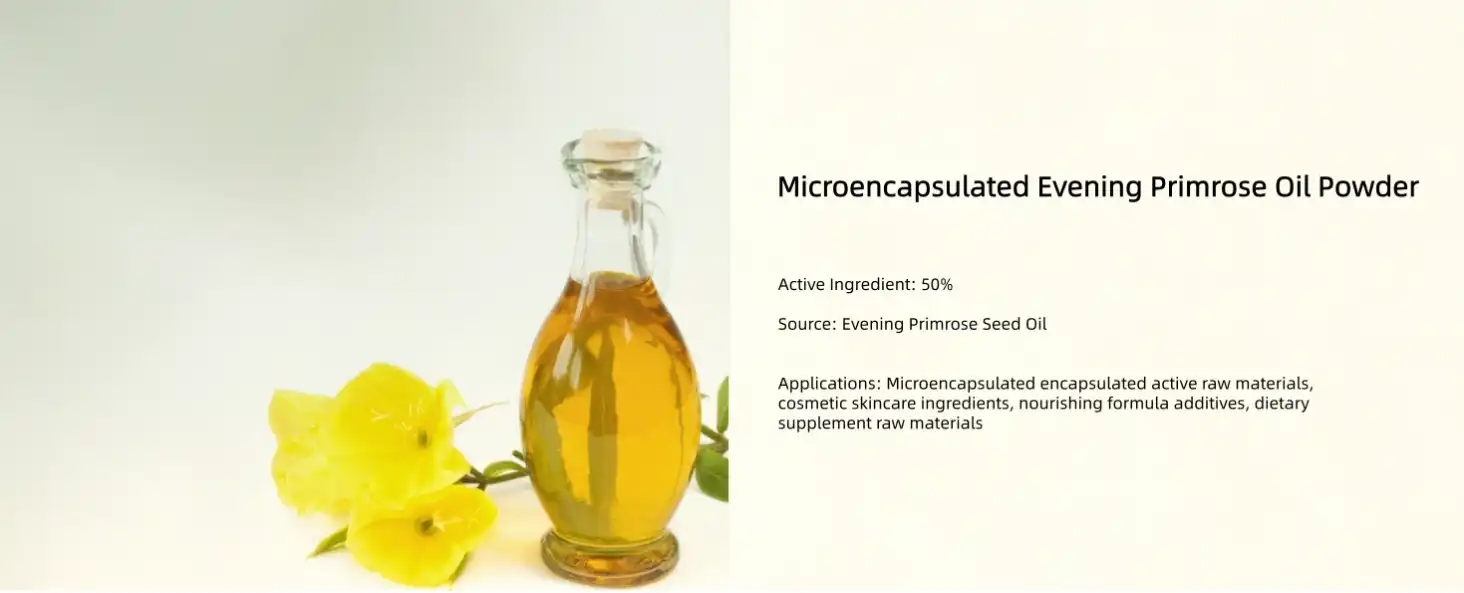
Microencapsulated evening primrose oil powder is a shelf-stable, free-flowing ingredient produced by enclosing cold-pressed Oenothera biennis seed oil within a protective micro-matrix through spray-drying. The process converts a liquid omega-6 oil — naturally rich in gamma-linolenic acid (GLA, CAS No. 506-26-3) — into an off-white to light yellow powder that resists oxidation, masks grassy odors, and blends cleanly into tablets, capsules, and stick packs. For brands building women's health or beauty-from-within product lines, this format solves the three biggest formulation headaches at once: rancidity, sensory off-notes, and liquid-handling complexity.
Understanding Microencapsulated Evening Primrose Oil Powder
What Microencapsulation Actually Does to the Oil
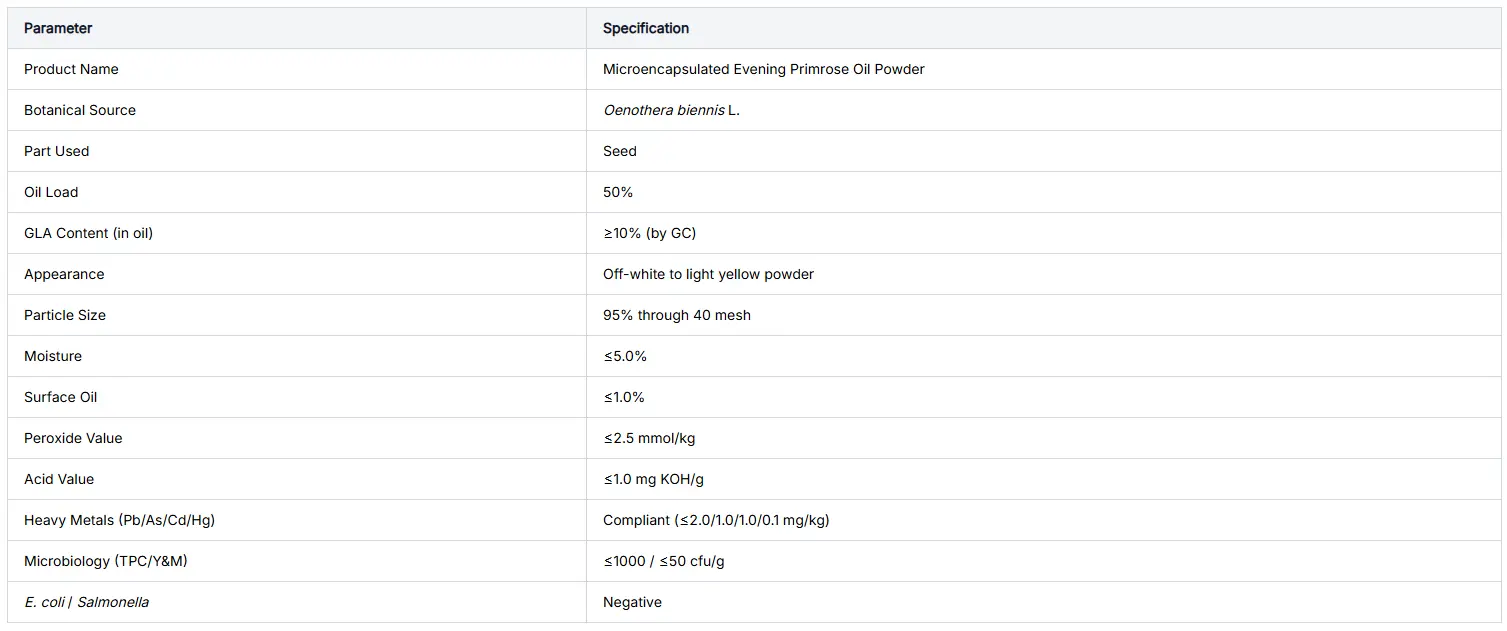
When raw evening primrose oil comes in contact with air, it breaks down quickly. When you spray-dry something, each oil droplet is wrapped in a carbohydrate or protein carrier. This makes a shield against air, light, and wetness. The end result is a powder that has a peroxide value of ≤2.5 mmol/kg and a surface oil content of ≤1.0%. These numbers show that the powder will not oxidize much when it is used. The shelf life is about 24 months when stored at room temperature, compared to 6–12 months for liquid oil that is not covered.
Key Quality Parameters You Should Verify
Three numbers are most important when judging any packaged GLA source: the oil load (should be at least 50%), the GLA concentration in the source oil (should be at least 10%), and the ratio of GLA to linoleic acid (real EPO is between 1:7 and 1:9). A strange ratio is the most obvious sign that the oil has been mixed with cheaper soybean or safflower oil. Ask for GC-MS results that are specific to each batch instead of just a general proof of analysis.
Certifications That Protect Your Brand
The compliance stack is important for brands that want to sell in the US, EU, or Australia. Look for manufacturing that is ISO-certified, GMP-compliant, Halal and Kosher-certified, FDA-registered, and USDA/EU Organic if your positioning calls for it. These qualifications lower the legal risk of labeling claims and make it faster for stores to start selling on Amazon or in natural health stores.
Health Benefits and Industrial Uses
GLA and Women's Health: What the Research Shows
GLA is an omega-6 fatty acid that the body changes into prostaglandin E1, a chemical that helps control inflammation and hormone signals. Clinical studies in journals like "Reproductive Health" and "The Journal of Reproductive Medicine" show that GLA from microencapsulated evening primrose oil powder can help ease the pain and mood changes that come with PMS. Regularly eating GLA has been linked to better epidermal barrier function, less transepidermal water loss, and a measurable decrease in the severity of eczema and acne.
Why Powder Outperforms Liquid in Product Development?
Making things with liquid EPO is harder. It needs to be filled with nitrogen, shipped in a refrigerator, and packed in soft-gel capsules. All three problems are solved by the powder structure. The particles that are 95% to 40 mesh mix evenly in high-speed tableting and encapsulation lines. The powder also spreads out cleanly in quick drink sachets without leaving behind any oily residue. Keeping things at room temperature also cuts down on the costs of the cold chain for shipping goods around the world.
Applications Across the Women's Wellness Category
The encapsulated powder can be used in a lot of different end product forms by brand owners who work with women's health. These areas of application are the busiest:
- Hard-shell capsules and compressed tablets targeting PMS relief, cycle regulation, and hormonal balance — the product passes 40 mesh for consistent fill weight and no capsule leakage.
- Functional stick packs and collagen blends for beauty-from-within positioning on TikTok, Amazon, and small-red-book channels, where GLA-plus-collagen combinations are a growing SKU category.
- Meal replacement and wellness powder blends that require a stable lipid source with neutral sensory impact, since the encapsulation shell masks the characteristic grassy note of raw oil.
All of these forms have one thing in common: they are oxidatively stable, which means they don't lose any nutrients when they are mixed, compressed, or left out in the open.
Market Comparison and Sourcing Considerations
Encapsulated Powder vs. Liquid Oil: A Practical Trade-Off
Even though liquid evening primrose oil costs less per kilogram of raw oil, it has extra costs further down the line that brands often don't account for, such as the need for special filling equipment, nitrogen packaging, cold-chain freight, and a shorter shelf life. Even though the powder costs more per unit, the total cost of making the product is often less when handling and waste are taken into account. Powder is not a fancy option for companies that make tablets or packs; it is the right choice for their business.
What to Compare When Evaluating Suppliers?
In a product market, you need an organized checklist to find microencapsulated evening primrose oil powder. The following things set trustworthy partners apart from low-cost risks:
- Batch-specific GC-MS reports confirming actual GLA percentage, not just a specification sheet value.
- Published GLA:LA ratios per lot, which serve as an anti-adulteration fingerprint unique to genuine Oenothera biennis oil.
- Flexible MOQ and lead time — a minimum order of 300 kg with a 3–5 day production window lets smaller brands test market without overcommitting capital.
- Dual-hemisphere supply continuity — sourcing from both Australia and Heilongjiang, China, ensures year-round availability regardless of seasonal harvest cycles.
There should be batch-specific GC-MS results that show the real GLA percentage, not just a number from the specification sheet.
Halal, Kosher, and Clean-Label Requirements
Buyers in the US and around the world are under more and more pressure from customers and stores to carry certified products. Check that the wall material used in the encapsulation (starch or gum arabic instead of gelatin) backs up a claim that the product is vegan or clean. Halal and Kosher certificates are needed to sell in stores in the Middle East and among Jews. Many Amazon-gated supplement categories now require them when you sign up.
Manufacturing Process and Quality Assurance
From Seed to Stable Powder: The Production Path
The seeds of Oenothera biennis L. are first cold-pressed to get the oil out. The oil is then degummed and deodorized to get rid of phospholipids and free fatty acids. The refined oil is then mixed with carrier materials and sprayed through a spray dryer at controlled temperatures that keep the purity of the GLA. The powder that is made is screened to make sure the particles are the right size (95% through 40 mesh), vacuum-packed, and kept in a building with controlled temperature until it is released by quality control.
Testing Protocols That Define Batch Integrity
Before being released, every batch at a reliable center goes through a set of tests. Gas chromatography (GC) confirms the full profile of fatty acids and the amount of GLA present. Surface oil research (solvent extraction method) checks that the sealing works. The TOTOX value, which is made up of the peroxide value and the p-anisidine value, checks for both primary and secondary oxidation. To finish the certificate of analysis, heavy metal tests (Pb ≤2.0, As ≤1.0, Cd ≤1.0, Hg ≤0.1 mg/kg) and microbiological tests (E. coli and Salmonella: negative; TPC ≤1,000 cfu/g) are done.
Traceability and Documentation for Global Compliance
For controlled markets, it is necessary to have a full traceability system that keeps track of where microencapsulated evening primrose oil powder raw materials come from, processing batch records, quality control data, and paperwork for shipments going out. Buyers should ask for full COA packages that come with the microbiological results, the encapsulated powder GC report, and the raw oil GC report. This should be a standard part of the delivery, not an extra cost.
How to Choose and Buy Microencapsulated Evening Primrose Oil Powder for Your Business?
Match Specifications to Your Finished Format
When a beverage brand mixes powder into a bag, the particles need to behave differently than when a capsule brand fills 500 mg hard shells. Before you ask for samples, you should know what particle size, oil load, and GLA you need. You can get custom oil loads of 30% or 70% for certain formulation needs. This lets you adjust the GLA dose per gram without changing how the rest of the blend is made.
Evaluate the Supplier's Technical Support Capacity
In addition to the ingredient itself, check to see if the supplier's expert team can help with label claim advice for your target market, formulation compatibility testing, and stability testing. When brands join the US market, they have to follow certain language rules set by the FTC and FDA for structure-function claims about PMS or skin health. It takes longer and costs more to meet those needs on your own, but a supplier with in-house R&D support can save you time and money.
Plan Your Procurement Cycle Around Supply Reliability
When it comes to names with reliable sell-through rates, quarterly replenishment rounds work best. Make sure that your supplier keeps standard specifications in stock and can make custom batches fit within your production window. Dual-hemisphere sourcing, where Australia's crop goes along with China's off-season, gets rid of the biggest supply risk in the EPO group, which is seasonal shortages that cause spot-market prices to go through the roof.
Conclusion
Evening primrose oil in the form of a microencapsulated evening primrose oil powder that is capsuled is not just an easy way to switch out ingredients. It is a formulation choice that impacts the security of the product, the ease of production, the trustworthiness of the label, and the experience of returning customers. For women's health brands that want to grow in the US market, GLA content integrity and proof of non-adulteration are the two things that make buyers trusting buyers into loyal stockists. Brands that can show what's inside the box will always do better than brands that can't. The easiest way to make a product line that can be expanded is to find a supplier that posts batch-specific GLA:LA ratios, keeps dual-hemisphere supply going, and has flexible MOQs.
FAQ
Is encapsulated evening primrose oil powder vegan-friendly?
It depends on what the wall is made of. Many types don't use gelatin but instead use starch or gum arabic, which makes them vegan and clean-label friendly.
How do I detect adulteration in EPO powder?
Ask for a GC-MS fatty acid profile that is specific to the batch and shows the GLA:LA ratio. Real Oenothera biennis oil always falls between 1:7 and 1:9. If the amount is not in this range, it means that soybean or safflower oil was used to thin it out.
Can the powder handle high-temperature blending?
The micro-matrix protects against heat in some way, which means that the powder can keep its GLA structure during normal mixing methods.
What is the typical shelf life?
However, any omega-6 ingredient shouldn't be exposed to heat for a long time above 80°C.
What MOQ and lead time should I expect?
Standard special batches start at 300 kg, and it takes 3–5 work days to make them. Standard specs that are in stock and ready to ship right away.
Partner With Easy Health — Your Microencapsulated Evening Primrose Oil Powder Supplier
For more than 11 years, Easy Health has been making plant extract ingredients that brands can actually check. Our evening primrose oil powder comes with a full COA, published GLA:LA ratios, batch-specific GC-MS data, and ISO/Halal/Kosher certification. This gives your quality team all the information they need to quickly approve a new ingredient. Custom oil loads, flexible MOQs starting at 300 kg, and supply in both hemispheres protect your production schedule all year long. To get a sample or talk about your formulation needs, go to easyhealthinc.com or email our team at devin@easyhealthbio.com.
References
1. Bamford, J. T. M., et al. "Oral evening primrose oil and borage oil for eczema." Cochrane Database of Systematic Reviews, 2013.
2. Chenoy, R., et al. "Effect of oral gamolenic acid from evening primrose oil on menopausal flushing." BMJ, 1994.
3. Horrobin, D. F. "The role of essential fatty acids and prostaglandins in the premenstrual syndrome." Journal of Reproductive Medicine, 1983.
4. Morse, N. L., and Clough, P. M. "A meta-analysis of randomized, placebo-controlled clinical trials of Efamol evening primrose oil in atopic eczema." Current Pharmaceutical Biotechnology, 2006.
5. Sergeant, S., et al. "Gamma-linolenic acid, dihomo-gamma linolenic, eicosanoids and inflammatory processes." European Journal of Pharmacology, 2016.
6. Tasset-Cuevas, I., et al. "Protective effect of borage seed oil and gamma linolenic acid on DNA." PLOS ONE, 2013.

_1784173402819.webp)