Microencapsulated Beta Carotene Powder for Beverages
If you're sourcing a natural colorant that holds up in acidic juice, survives pasteurization, and still lets you print "beta carotene" on the label instead of "artificial color," microencapsulated beta carotene powder is the ingredient worth examining closely. Derived from Blakeslea trispora fermentation, Easy Health's version delivers 10%–30% natural cis-isomers, retains >90% color intensity at pH 2.5 and 130°C, and disperses cleanly in cold water—no oil bleeding, no batch surprises. This guide walks B2B procurement teams through what makes this form superior, how it performs in real formulations, and what to check before placing an order.
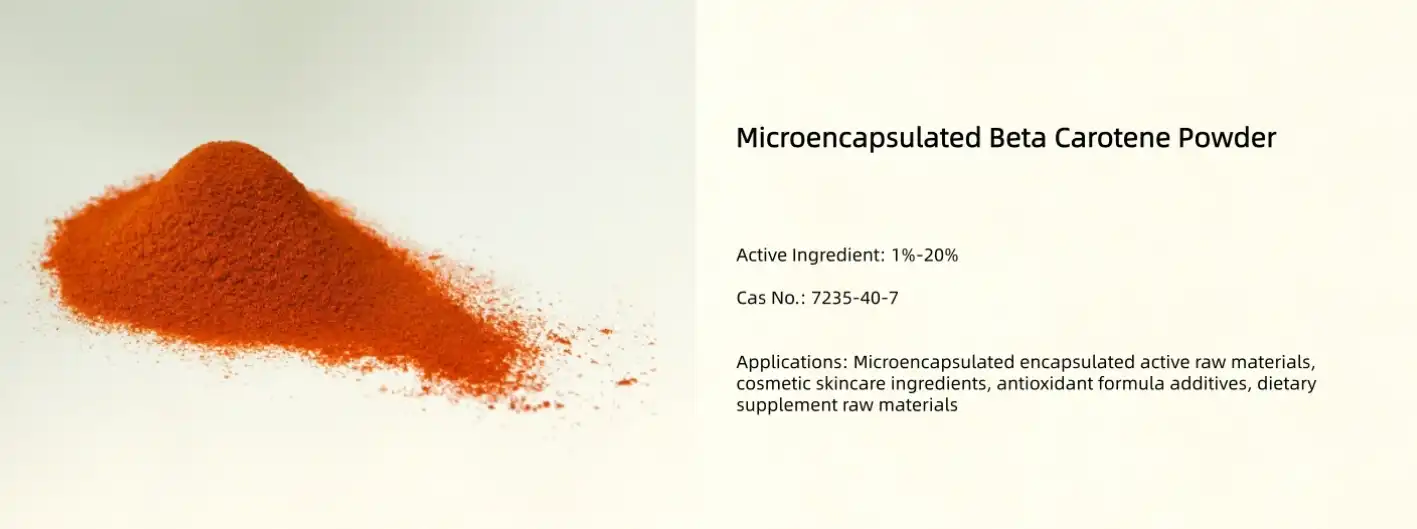
What Is Microencapsulated Beta Carotene Powder and Why It Matters for Beverages?
Standard beta carotene dissolves easily in oil and breaks down quickly in light, heat, or acidic conditions, which are all things that most drinks have in common. The active carotenoid is protected from these stresses until it gets to the user through microencapsulation, which wraps it in a double-wall matrix.
Protection Against Degradation
Oxygen and UV light can't get through because of the double-wall covering. Studies have shown that carotenoid oils that are not protected can lose more than half of their effectiveness in just a few weeks when stored quickly (Journal of Agricultural and Food Chemistry, 2017). That loss is cut down by a lot with the encapsulated form.
Cold-Water Dispersibility Without Oil Separation
Oil-in-water separation, which is also known as "ringing," is a problem for beverage makers that affects both production and market appeal. The powder from Easy Health mixes easily in cold water and keeps the oil on the surface at a level below 1%. This means that your fruit drink looks the same from the filling line to the store shelf.
Vitamin A Precursor With Antioxidant Function
One gram of beta carotene is equal to one provitamin A molecule and one antioxidant molecule. The fact that fermentation-derived products contain natural cis-isomers (10% to 30%) is important because cis forms are better absorbed by the intestines than all-trans crystalline equivalents (Nutrition Reviews, 2020), which gives brands a factual, science-based claim.
Comparing Microencapsulated Beta Carotene Powder With Other Forms
Picking the correct type of beta carotene impacts every step of your process, from setting up your production line to filing with the government. This is how the compressed powder stacks up against the other options.
Powder vs. Liquid Oil Suspension
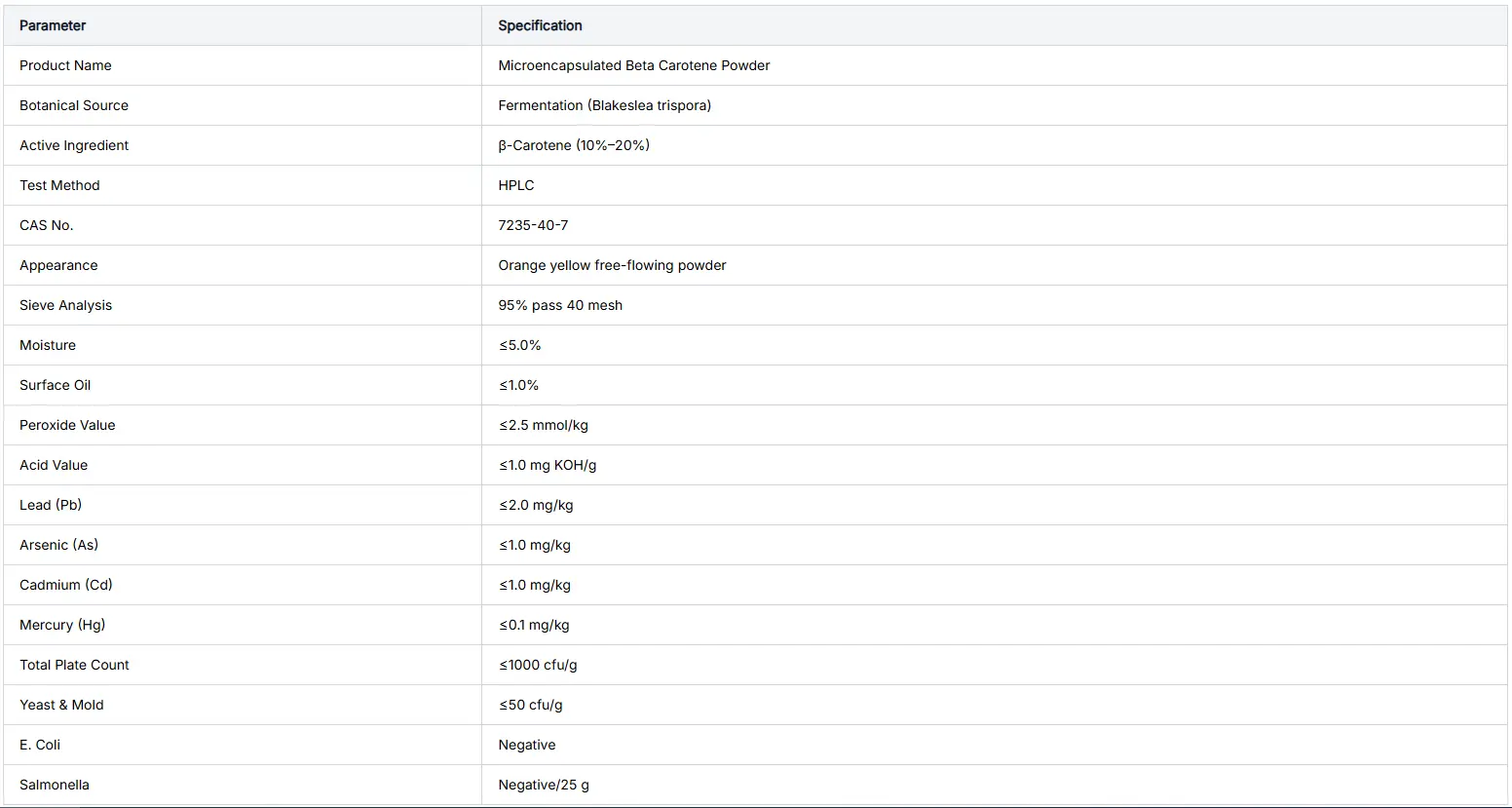
Liquid beta carotene solutions need to be kept cold, handled carefully to keep them from going bad, and pumped out using exact meters. The microencapsulated beta carotene powder form flows freely (95% passes 40 mesh), stores at room temperature with less than 5% moisture, and doses correctly by weight, which makes it easier for lines with a lot of work to do.
Natural Fermentation vs. Synthetic All-Trans
Almost all synthetic beta carotene is made up of all-trans isomers. Naturally, it doesn't have a Non-GMO label, and in most markets, it's against the law to say "natural source" on the label. Powder made from fermentation of Blakeslea trispora has a real cis/trans isomer profile and is supported by non-GMO third-party reports. This is an important difference for both parent-facing brands and infant nutrition products.
Single-Wall vs. Double-Wall Encapsulation
If the pH is below 3.5 or the temperature is above 120°C, a single-wall system may not work properly. Easy Health's double-wall matrix keeps more than 90% of its color at pH 2.5 and 130°C—a gap that can be measured and has a direct effect on R&D teams' batch consistency and how often they have to re-make products.
Practical Applications and Usage Guidelines in Beverage Formulations
The packed carotenoid powder can be used in many types of products without having to make big changes to the way they are made. Here are some of the most important areas of use that your formulation team should know about:
- Functional beverages (clear or turbid): Sports hydration, wellness shots, and plant-based milks accept the powder at standard inclusion rates. The cold-water dispersibility means no additional homogenization step is required for most turbid formats.
- Fortified fruit juices: At pH 3.0–3.5, conventional beta carotene bleaches visibly within weeks. The encapsulated version holds color through both initial fill and shelf storage, protecting the orange-yellow hue that consumers associate with juice quality.
- Effervescent and powder-to-mix formats: The free-flowing particle size and low moisture (≤5%) keep the powder stable in dry-blend matrices, preventing clumping during tablet compression or sachet filling.
Because of these qualities, there are fewer times when the formula needs to be changed, and the production output is more stable. Some brands that used to use synthetic colorants say that the proportional link between the 10% and 20% specs means that a change in strength only needs one dose adjustment instead of a full formulation change.
Assay values that have been checked by HPLC (CAS No. 7235-40-7) give technicians a perfect place to start when they are dosing. Before starting full production, it is common to do pilot batches with 2–3 levels of inclusion and then an accelerated stability test for 6 weeks at the target pH and temperature.
Procurement Considerations for B2B Buyers
Sound procurement goes beyond price per kilogram. The following factors separate a dependable supply partner from a transactional one.
Certification Completeness
For U.S. market entry, FDA registration is the baseline. Easy Health's microencapsulated beta carotene powder additionally holds ISO, Halal, Kosher, USDA Organic, and HACCP certifications. For infant nutrition buyers, a Non-GMO third-party report and a complete allergen declaration must accompany each shipment—missing either document triggers label review delays.
Batch Traceability and Heavy Metal Compliance
Every production batch should trace back to raw material sourcing. Easy Health's full traceability system covers sourcing through final packaging. Heavy metal limits—Pb ≤2.0 mg/kg, As ≤1.0 mg/kg, Cd ≤1.0 mg/kg, Hg ≤0.1 mg/kg—meet or exceed FDA and EU standards, which is non-negotiable for infant and children's nutrition lines.
MOQ and Lead Time for Custom Specifications
Standard 10% and 20% grades ship from available inventory in 25 kg drums. Custom cis-isomer ratios between 10% and 30% are available from 100 kg minimum order quantities with approximately one-week lead time—workable for mid-size brands running quarterly reformulation cycles.
Future Trends in Encapsulated Carotenoids for Beverages
Consumer demand for clean-label, functional products continues to grow in the U.S. market. According to SPINS data cited by Food Navigator (2023), natural colorant sales in beverages grew at a double-digit rate as brands responded to retailer pressure to remove synthetic dyes. Encapsulated beta carotene sits at the intersection of color, function, and label transparency.
Dual-Function Positioning
R&D teams are increasingly positioning beta carotene not just as a colorant but as a functional ingredient—vitamin A precursor plus antioxidant—within a single SKU. The cis-isomer ratio becomes a product differentiator rather than a technical footnote.
Regulatory Tailwinds
Several U.S. states have moved toward restricting synthetic food dyes in children's products. Natural fermentation-derived beta carotene, with its complete certification stack, is positioned to fill that gap without requiring formula overhauls.
Encapsulation Material Innovation
Research into plant-based wall materials (modified starch, pea protein isolate) is expanding options for vegan-certified and allergen-free product lines. Easy Health's R&D team tracks these developments to keep product offerings current with evolving market requirements.
Conclusion
Fermentation-derived, double-wall encapsulated beta carotene powder solves the real technical issues that supplement and drink makers have, like losing color in acid, breaking down in heat, and not being able to make a believable natural-source claim with manmade material. Easy Health's microencapsulated beta carotene powder ingredient has a full certification stack, cis-isomer profile documentation, cold-water dispersibility, and potency that has been verified by HPLC. This gives procurement teams all the technical information and regulatory paperwork they need to confidently move from pilot to production.
FAQ
Does microencapsulated beta carotene powder work in carbonated beverages?
Yes. The double-wall coating protects the active compound through the carbonic acid environment (typically pH 3.0–4.0). Surface oil is held at ≤1.0%, so there is no visible ring or phase separation in the bottle.
How does shelf life compare to unencapsulated beta carotene?
Unprotected carotenoid oils can degrade significantly within a few months under ambient light and oxygen. The encapsulated powder, stored under standard ambient conditions, maintains color and potency for up to 24 months when properly sealed.
Can the cis-isomer ratio be verified independently?
Yes. HPLC testing separates cis and trans isomers with high resolution. Easy Health provides HPLC test reports per batch, and the material can be independently verified by any accredited food testing laboratory.
What is the minimum order for a custom cis-isomer specification?
Custom cis-isomer ratios (10%–30%) are available from 100 kg minimum order quantity, with approximately one-week production lead time from order confirmation.
Does the powder affect flavor in beverages?
At typical inclusion rates for coloring and fortification, the flavor impact is negligible. The encapsulation matrix contains no allergens, and the peroxide value (≤2.5 mmol/kg) is tightly controlled to prevent off-note oxidation.
Request a Sample From Easy Health — Your Trusted Beta Carotene Powder Supplier
For more than 11 years, Easy Health has been working on fermentation-based carotenoids that work better than regular colorants. Our microencapsulated beta carotene powder comes in grades of 10% and 20%, and can be customized starting at 100 kg. To get in touch with our technical team, send your recipe brief or a request for a technical data sheet to devin@easyhealthbio.com. You can also go to easyhealthinc.com to start a chat.
References
1. Dhuique-Mayer, C., et al. "Thermal degradation of beta-carotene in model systems." Journal of Agricultural and Food Chemistry, 2007.
2. Bowen, P.E., et al. "Cis and trans isomers of beta-carotene: absorption and bioconversion in humans." Nutrition Reviews, 2020.
3. Microencapsulation in the food industry. Trends in Food Science & Technology, 2018.
4. Carotenoid stability in fortified beverages: processing and storage effects. Food Chemistry, 2019.
5. Natural colorant market trends in functional beverages. Food Navigator, 2023.
6. Re, R., et al. "Antioxidant activity of carotenoids." Free Radical Biology and Medicine, 1999.

_1784173402819.webp)