How To Use Liposomal Reduced Glutathione Powder
Liposomal reduced glutathione powder is one of the most technically advanced antioxidant ingredients available to supplement and functional food brands today. Standard oral glutathione breaks down in the digestive tract before it reaches the bloodstream, delivering less than 10% absorption. The liposomal format solves this by wrapping the reduced GSH tripeptide inside a phospholipid bilayer (≤120nm), protecting it through the GI tract and enabling direct cellular uptake. For brands in skin brightening, liver health, anti-aging, or immune support, this ingredient represents a measurable formulation advantage.
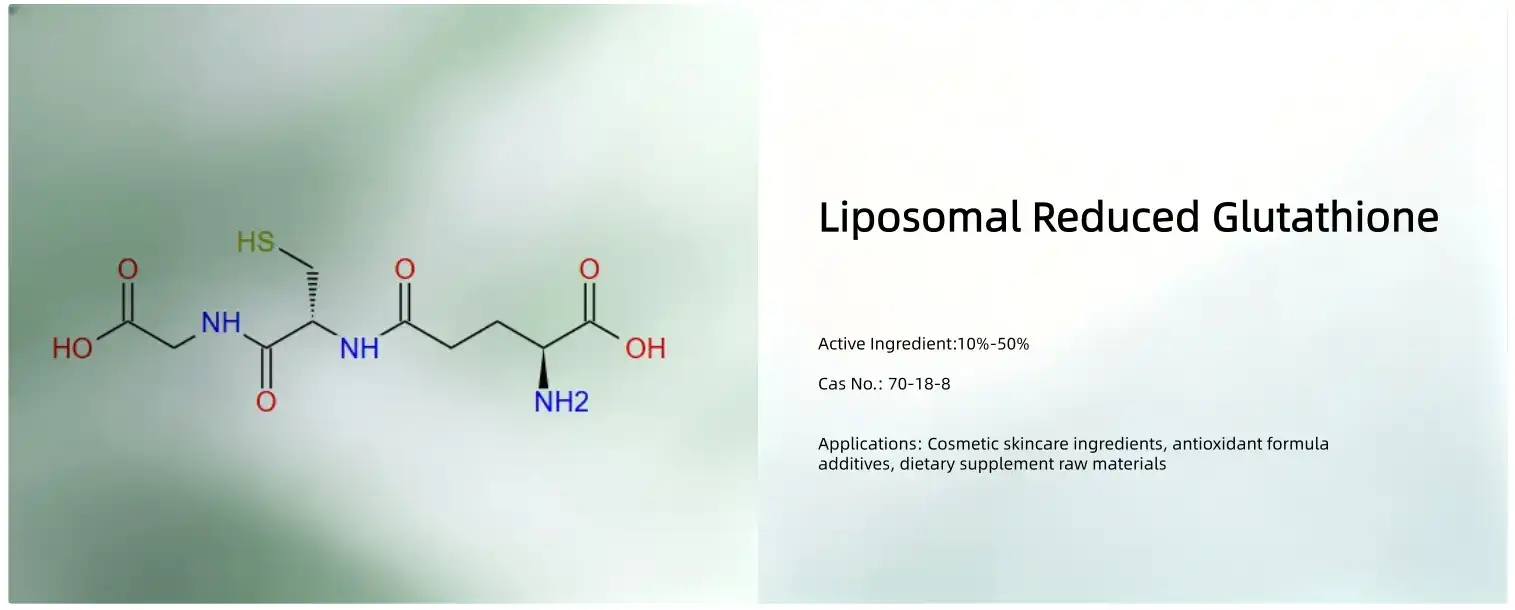
Understanding Liposomal Reduced Glutathione Powder
What It Is and How It Differs from Standard Glutathione
Liposomal reduced glutathione powder (CAS No. 70-18-8) is made by microbes fermenting sugars. It's a light yellow powder that flows easily and has a reduced GSH purity of at least 98%, which can be checked by HPLC. Standard glutathione supplements are mostly broken down in the stomach into individual amino acids. The liposomal version, on the other hand, contains the whole tripeptide within very small lipid bubbles. The difference between an antioxidant that just sounds good and one that actually gets to the right cells is this structural defense.
Core Antioxidant Functions
GSH (reduced glutathione) is the body's main antioxidant that stays inside cells. It directly gets rid of reactive oxygen species, turns oxidized vitamins C and E back into active forms, and starts Phase II liver detoxification, the metabolic pathway that gets rid of drug and alcohol metabolites and environmental toxins. According to a study released in the journal Free Radical Biology and Medicine, GSH loss is closely linked to cells aging faster and the immune system not working as well. Taking supplements to keep intracellular GSH levels high needs a way to give the supplements that doesn't go through the digestive system.
Safety Profile and Dosage Guidance for Formulators
There is a lot of evidence that reduced glutathione is safe to use in functional foods and dietary supplements. Most finished products that use the liposomal form have doses between 250 mg and 500 mg per serving. This is a lot less than the 1,000 mg+ that is usually needed with non-encapsulated GSH to get the same plasma levels. Lead levels of ≤2.0 mg/kg, Arsenic levels of ≤1.0 mg/kg, Mercury levels of ≤0.1 mg/kg, and Total Plate Count levels of ≤1,000 cfu/g are all well below the safety standards. Salmonella and E. coli tests came back negative.
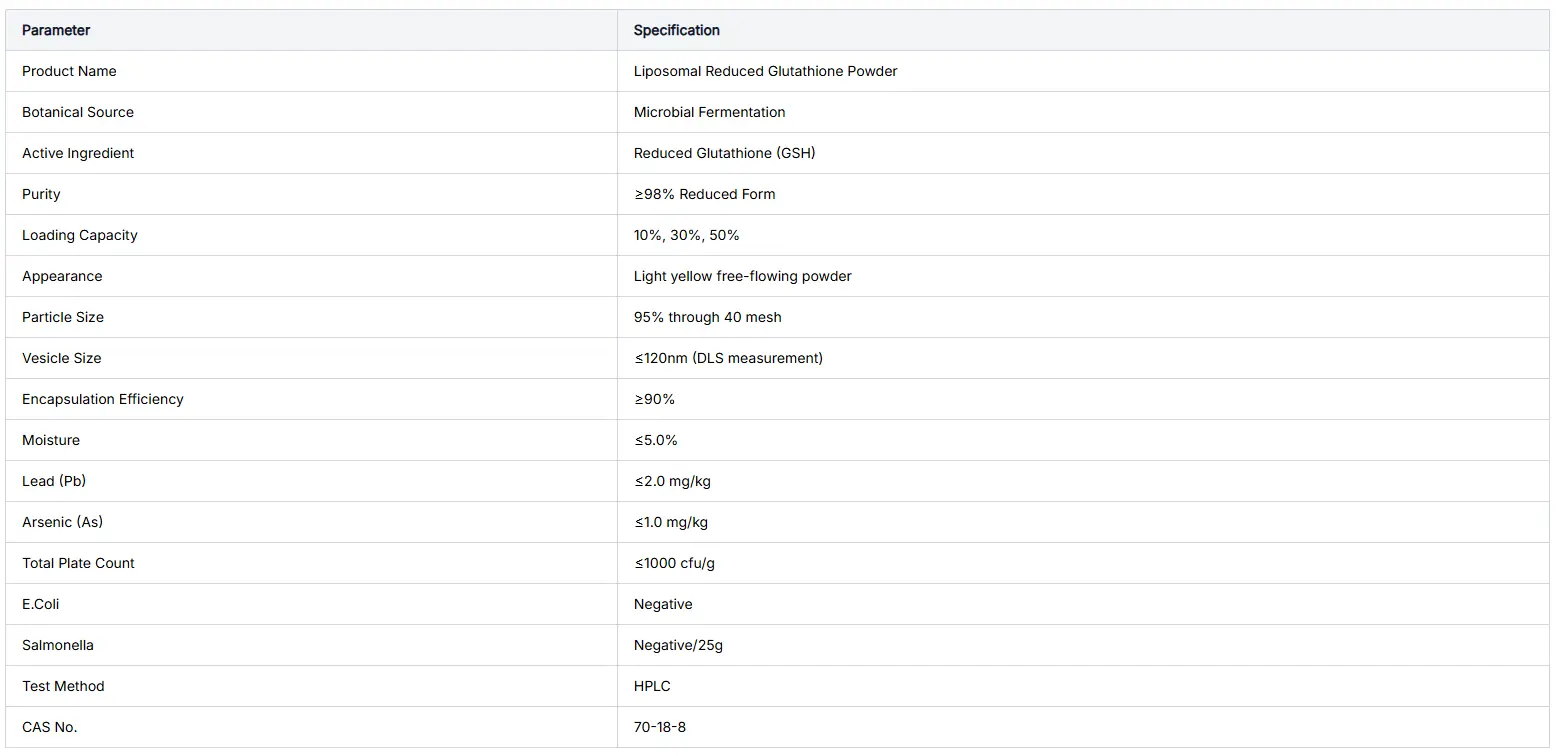
How to Use Liposomal Reduced Glutathione Powder Effectively?
Dosage by Application Category
What you need to include depends on the type of product you're making and the people you want to buy it. This is a useful split that buying and formulation teams often use:
- Oral beauty supplements (skin brightening, anti-pigmentation): 250–500 mg GSH equivalent per serving. At this range, the liposomal delivery maintains sufficient systemic plasma levels to support melanin pathway modulation.
- Liver health and detox products (liver protection tablets, hangover recovery): 300–600 mg per serving. Phase II detoxification demands sustained hepatic GSH availability, making the protected liposomal format particularly relevant.
- Anti-aging and antioxidant capsules: 250–500 mg per serving, often combined with vitamin C to support GSH recycling.
These ranges show that liposomal reduced glutathione powder is more bioavailable than regular GSH, where absorption may need 3–5 times higher doses to get the same results.
Stability and Storage Best Practices
If it is not properly protected, reduced GSH easily oxidizes during processing and storage. Our product is fully protected by nitrogen microcapsules, which keeps the reduced form retention at >90% while it is being made. Follow these storage and handling rules for your production area: keep things cool and dry, away from direct light and heat; don't let them be exposed to air for long periods of time while they're being mixed; and make sure that your preparation process doesn't add any damaging agents. measure stability tests (25°C/60% RH) shows that GSH content stays at least 85% for 6 months, which is an important shelf-life measure for final products.
Real-World Application Scenarios
The liposomal structure works in three different types of product situations. In high-end nutraceutical capsules, it brightens the skin in a way that can be measured and costs less per dose than oral options that are close to an IV. In ready-to-mix packets and functional drinks, the enclosed structure doesn't break down when the pH level drops, which is what happens to regular GSH in liquid forms. In clinical nutrition and healing goods after surgery, it helps keep plasma GSH levels high for patients whose intestinal absorption isn't working well, which is a need that regular powder ingredients can't meet.
Comparing Liposomal Reduced Glutathione Powder with Alternatives
Liposomal Powder vs. Standard Oral GSH
In the gut, standard glutathione powder is broken down into its three amino acids: glutamate, cysteine, and glycine. These are then taken separately and need to be put back together inside cells. This method doesn't work well. Standard oral GSH has less than 10% bioavailability, according to absorption studies. Liposomal formulations, on the other hand, raise plasma GSH levels much more significantly in clinical observations. The liposomal form is a perfectly valid way for brands that market high-end goods to set themselves apart.
Liposomal Powder vs. IV Glutathione
Intravenous glutathione is given in clinical settings only, but it is almost completely bioavailable. Liposomal reduced glutathione powder is an economically scalable oral replacement that supplement companies can use to target the growing "IV drip alternative" market in the US. It lets companies sell high-absorption GSH without having to deal with the complicated rules that come with injectable forms.
Reduced (GSH) vs. Oxidized (GSSG) Forms
Most of the glutathione on the market has been partly or fully oxidized to GSSG, which is the inactive disulfide form. GSSG doesn't do much to protect cells from damage and doesn't effectively replenish intracellular GSH pools. Our requirements promise a GSH reduction of at least 98%, and the GSH/GSSG ratio is checked for each batch. This batch-by-batch checking is the quality control step that tells the difference between active ingredients and inert fillers.
Sourcing and Procuring Liposomal Reduced Glutathione Powder
Key Supplier Evaluation Criteria
Before making an order, buying managers should ask for the following test results and paperwork from a liposomal reduced glutathione powder supplier:
- HPLC assay confirming reduced GSH ≥98% and per-batch GSH/GSSG ratio reports
- DLS particle size data confirming vesicle diameter ≤120nm and PDI <0.3 for uniformity
- Encapsulation efficiency ≥85% verified through ultracentrifugation testing
- Heavy metal and microbial certificates meeting pharmacopeial standards (USP/EP)
- Nitrogen-protection processing documentation confirming reduced form retention ≥90% during manufacturing
You should be wary of suppliers who can't give you these specific test reports for each batch. This is especially important because oxidized GSH is still widely mixed in with commodities and sold as the real thing.
Bulk Purchasing and Lead Times
Core buyers usually buy between 2 and 15 metric tons of goods every year, based on the type of goods they buy. Standard specs (10% to 50% GSH loading) are kept in stock so that they can be sent out quickly. Custom requirements can usually be met in three to five days. Working with a source that lets you track everything from where the raw materials come from to when the final QC release is made lowers the risk in the supply chain and helps you with your product compliance paperwork.
Regulatory and Compliance Considerations
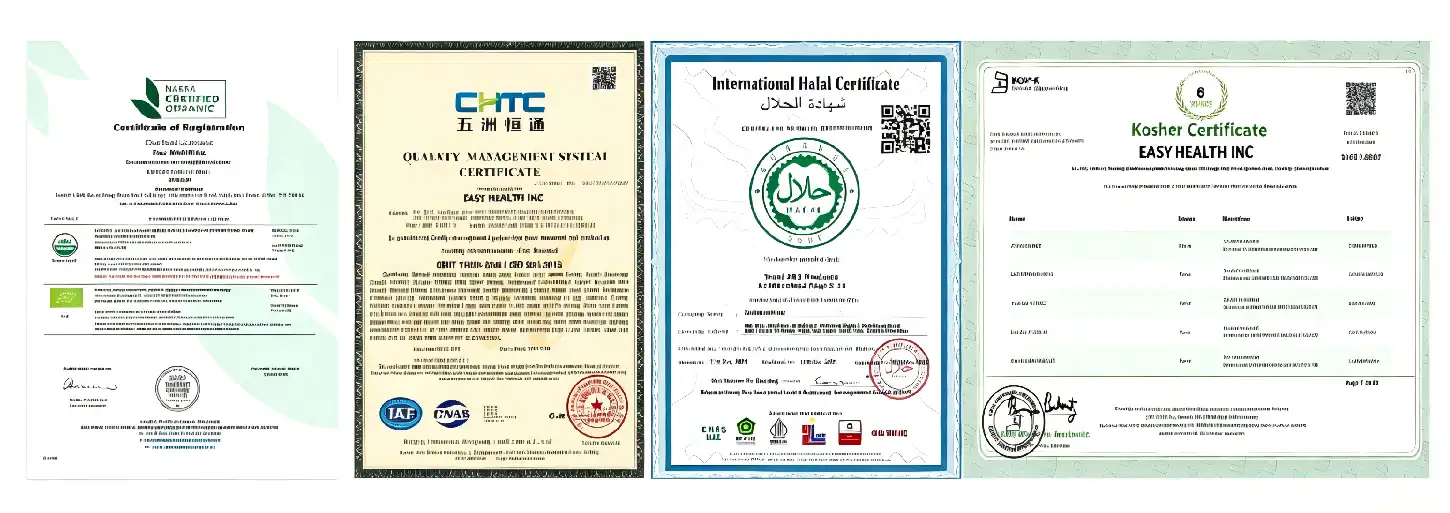
Dietary ingredient suppliers in the US market have to follow FDA 21 CFR Part 111 cGMP rules. Suppliers with ISO, Halal, Kosher, and HACCP certifications leave an audit trail that makes it easier for you to register your products. If a brand makes claims about brightening the skin, your supplier should be able to give you peer-reviewed clinical references and information on how to follow the rules in each target market.
Strategies for Integrating Liposomal Reduced Glutathione Powder Into Your Product Line
Matching the Ingredient to Your Category
With GSH loading ranges from 10% to 50%, formulators can find the right amount of strength for a variety of product types. When dosage concentration is important, like in capsules and tablets, a 50% loading works well. A 10%–20% loading works well for sachets, stick packs, or drinks where volume, masking taste, and spreading the powder are more important.
Addressing Common Formulation Challenges
Most of the time, formulation problems with GSH chemicals are caused by oxidation while mixing, masking of taste, and longevity claims on the label. All three are taken care of by the nitrogen-encapsulated liposomal structure. The microencapsulation shell guards against the risk of oxidation during processing. The lipid coating covers up a lot of the sulfur off-note that comes from raw GSH. And the confirmed 6-month stable data (≥85% GSH retention at 25°C/60% RH) backs up the clean, correct label claims for the whole shelf life of your product.
Future Market Positioning
The global glutathione market is growing beyond skin health to include neuroprotection, sports recovery, and cosmetics after surgery. Now, brands that base their formulas on proven lower GSH with liposomal delivery are getting ready for the next wave of antioxidant product creation. New research into GSH's role in protecting neurons and keeping mitochondria working properly is giving supplement brands that are thinking ahead new product brief ideas.
Conclusion
Liposomal reduced glutathione powder fills in the gaps between what we know about GSH from science and how well it works in the real world. The technical specs are important for procurement workers looking for ingredients for lines of products that brighten skin, protect the liver, fight age, or boost the immune system: reduced form purity ≥98%, vesicle size ≤120nm, encapsulation efficiency ≥85%, and nitrogen-protected processing. These are not marketing claims; they are quality standards that can be checked against each batch. If you want your finished product to live up to what it says on the label, you need to buy ingredients from a supplier who can back up every standard with test data.
FAQ
Why does the reduced (GSH) form matter more than the total glutathione content?
The amount of glutathione in the body is measured by its total content. However, only the reduced form (GSH) is an antioxidant. Oxidized glutathione (GSSG) does not do anything and does not refill antioxidant stores in cells. A product with a lot of total glutathione but not much GSH/GSSG ratio doesn't do much good.
What particle size is required for effective liposomal delivery?
Dynamic Light Scattering (DLS) shows that the vesicle's width should be less than 120nm. It's harder for bigger particles to move through the membranes of the intestines. If the PDI number is less than 0.3, it means that the vesicle population is uniform. This means that bioavailability will be the same across production runs.
How should I store the bulk ingredient to protect activity?
Keep in cool, dry places away from direct light and heat, in containers that have been sealed and gassed with nitrogen. Do not open packages where it is warm. In the right conditions, the GSH content stays at least 85% for 6 months (data from 25°C/60% RH stability).
What is the typical inclusion rate for a skin brightening supplement?
When using the liposomal format, a finished oral vitamin should have between 250 and 500 mg of encapsulated GSH equivalent per dose. This is because liposomal forms are better at being absorbed than non-encapsulated forms.
Partner with Easy Health for Your Next Formulation
Every B2B partnership that Easy Health works with is backed by its more than 11 years of experience in plant extracts and nutraceutical ingredients. Our liposomal reduced glutathione powder maker can do HPLC-verified reduced GSH ≥98% testing, per-batch GSH/GSSG testing, ≤120nm vesicle size, and full nitrogen-protected processing. We are certified by ISO, Halal, Kosher, FDA, and HACCP to back up all of these services. You can choose from specifications ranging from 10% to 50% GSH loading. You can ask for samples and scientific information by emailing devin@easyhealthbio.com or going to easyhealthinc.com.
References
1. Pizzorno, J. (2014). Glutathione! Integrative Medicine: A Clinician's Journal, 13(1), 8–12.
2. Richie, J. P., et al. (2015). Randomized controlled trial of oral glutathione supplementation on body stores of glutathione. European Journal of Nutrition, 54(2), 251–263.
3. Ballatori, N., et al. (2009). Glutathione dysregulation and the etiology and progression of human diseases. Biological Chemistry, 390(3), 191–214.
4. Allen, J., & Bradley, R. D. (2011). Effects of oral glutathione supplementation on systemic oxidative stress biomarkers in human volunteers. Journal of Alternative and Complementary Medicine, 17(9), 827–833.
5. Sinha, R., et al. (2018). Oral supplementation with liposomal glutathione elevates body stores of glutathione and markers of immune function. European Journal of Clinical Nutrition, 72(1), 105–111.
6. Weschawalit, S., et al. (2017). Glutathione and its antiaging and antimelanogenic effects. Clinical, Cosmetic and Investigational Dermatology, 10, 147–153.

_1784173402819.webp)